Zettelkasten Online

The ubiquitous habit of modern digital note-taking: the urge to tag every concept, keyword and fleeting idea you encounter. But this method often strips the core architecture of a true knowledge system, leaving users with a flat, disconnected “pile of leaves” and an overwhelming “information swamp.”

You can do plain old digital tagging easily enough, but people often say that this produces messy databases rather than cohesive second minds. In the Mind Dump Zettelkasten, we solve these basic problems with a very disciplined method called Frugal Indexing.

Here’s a look at the three biggest accusations against standard digital tagging, and how our frugal tagging system systematically solves them.

1. The “Mention Linking” Epidemic vs. Ancestor Suppression

The Accusation: Standard digital tools encourage “mention linking” where each separate note with a particular keyword is tagged. That makes the tag a lot cheaper. If you have a deep, fundamental idea buried in a throwaway reference to that idea, your index is bloated and useless. All notes are incorrectly assigned the same class of importance.

The Thrifty Approach: Mind Dump actively fights tag bloat with the Ancestor Suppression rule. Under this strict AI directive, tag placement is done only once in any horizontal branch. The system is expressly prohibited from applying the same tag to a child note multiple times, in the event that a parent or ancestor note already possesses that tag. This ensures your tags stay relevant and are only used for the core concepts and not passing mentions.

2. Flat Search Results versus Real Entry Points

The Charge: Standard tagging is like a search engine for retrieving knowledge. Most apps will give you a flat, linear list of search results when you click on a tag. It removes your thoughts from their rich, surrounding context and ignores the structural relationships among them.

The Easy Fix: Frugal indexing makes tags a very curated map instead of a dumb keyword filter. Downstream child notes don't have redundant tags (thanks to Ancestor Suppression) so you don't get to scroll through a flat list of search results. Instead, the tag is a designated “entry point” for the top-most relevant node of a thought. You are invited, from that entry point, to explore the Folgezettel (the associative branching tree) in an organic fashion, to find the rest of the conversation.

3. Risk of Black Holes vs. Starvation Override

The Allegation: In a naturally branching system there is a danger of creating “black holes”: isolated branches of knowledge that fade away from your memory because they have no connections and are not easy to find. A system that tags too sparingly risks the orphaning and loss of whole paradigms of thought.

The Budget Option: Mind Dump uses the Starvation Override rule to keep valuable ideas from disappearing. Each time a new Root note is added, i.e. a new paradigm or field of knowledge is added to the matrix, the AI needs to create at least one new tag as an entry point. The tags are never allowed to be empty on a new root in the system. Thus, no new branch of knowledge is ever lost in the matrix, without a reliable map back to it.

The Sentence

Mind Dump’s frugal indexing shows that you don’t have to give up the organic, structured magic of a traditional Zettelkasten, just because you are using software. It helps you build a curated map to your knowledge by hampering redundant tags and root entry points, so your second mind is a space of profound exploration, rather than a flooded database.
In our modern digital age there’s a common question that arises for anyone considering the Zettelkasten method: “Surely I can get the same information from the internet and AI without building a Zettelkasten?”

It sounds reasonable on the face of it. In our pockets we hold the sum of human knowledge. A simple prompt to ChatGPT or a Google search can yield answers to almost any question in seconds. But you can definitely get an answer this way, but relying only on the internet and AI takes away the most important part of intellectual growth, which is the complete control of your sources and the development of your own mind.

Here’s why Zettelkasten is still a much better way to build a tool for serious thinkers, writers and creators.

Losing control in the sea of information

If you rely on web searches or general AI models, they collect and compile information from across the web. But it is convenient and they can quote stuff from sources you don't approve of, or that have never been rigorously checked for truth. You’re outsourcing your intellectual underpinning to an algorithm.

As we have discussed in our investigation of the Zettelkasten, the ultimate goal of a creator is to create knowledge based on an honest search for truth. With Zettelkasten, you are a ruthless gatekeeper. Each note in your system is an idea that you've read and vetted yourself, and found so irresistible that you extracted You are not basing your decision on a black-box algorithm, you are basing your decision on your own highly curated library of trusted insights.”

The AI Silo (The NotebookLM Problem)

Of course, you could use fantastic bounded AI tools like Google’s NotebookLM that only pulls from the specific sources you give it. That solves the problem with the open web, but it creates a whole new set of challenges.

If you are not very selective about the sources you upload, then feeding tens or hundreds of pages of text into an AI tool without vetting means you could easily feed in data you don’t want to rely on. And also, something like NotebookLM is built to focus on particular topics or projects. It works in a silo. A Zettelkasten, on the other hand, is meant to take in a wide variety of knowledge from your life, waiting for you to pull cross-disciplinary information at any moment in time. It’s not a project folder, it’s a life-long “second mind”.

Avoiding the Fallacy of the Collector

The internet is a never ending source of raw data and information for us. But there is a big difference between information and knowledge. Knowledge = Information x Meaning

We are in the “Collector's Fallacy” just by bookmarking web pages or storing huge PDFs into an AI database. This is the dangerous tendency to collect information but not to actually process it to understand its meaning. Knowledge is not unstructured accumulation. It is psychological burden and overwhelm. As is well understood by experts, the knowledge acquired purely through passive reading, without actively creating considered notes, is highly superficial .

A Zettelkasten makes you slow down. You cannot simply copy and paste. You have to put the idea in your own words, which is a powerful mnemonic device, “neuroimprinting” the knowledge deep into your brain.

Contextualising, Not Just Drawing Consequences

When you ask an AI a question, it will give you a literal, encyclopedic summary of the facts, usually. But true genius-level thinking requires getting out of this “Encyclopedic Trap.”

A Zettelkasten makes you do the “So What?” test. You are actively removing the literal nouns and mechanical jargon to find the deep , underlining Intellectual Consequence of an idea . By making your notes about the final outcome or the fundamental truth about human behaviour, you force your ideas to be ready to be connected to a completely different field in the future.

Magic of Bisociation

In the end, a Zettelkasten is not an information storing database, but a “alter ego” and communication partner.

And because your notes are decomposed into atomic thoughts and connected structurally through an organic branching tree, the system begins to produce unforeseen “structured accidents”. You’re going to be researching a mathematical concept like Blockchain and your Zettelkasten will give you a “magic vine” (a remotelink) that connects it directly to a note you wrote three years ago about human behavioural economics This is called a Bisociation: the bringing together in the mind of one idea derived from two quite different disciplines at one and the same time.

No internet search engine, no AI can invent these deeply personal,creative collisions because they lack the historical context of your changing consciousness and your specific past thoughts.

The Judgement

You can absolutely use the internet for quick facts and you can use AI to summarise documents. But if you want to evolve your mind, create breakthrough insights and build a trustworthy system that liberates you from the mental strain of memory recall, there are no shortcuts. You are the one who has to build the Zettelkasten.

You have given me so much information on how to build my atomic notes, the consequences of a note and placement rules. I’m beginning to think that I’ll never be able to get this down and make it work.

If you’ve ever had this thought, you’re not alone. This is such a common feeling when you first start building a Zettelkasten. It is very natural to be paralysed by the fear of putting a note in the “wrong” place when you are trying to do the heavy intellectual lifting of judging “consequences” and at the same time manage the mechanics of a new structural system.

But the fear of getting it wrong is based on a fundamental misunderstanding of what a Zettelkasten actually is. Here’s why making a mess is not just fine but actually necessary for the system to work.

The Perfectionism Trap:

The biggest hurdle users face when building a Zettelkasten is perfectionism. Thanks to digital folders and encyclopedias, we’ve been conditioned to believe knowledge must be organised perfectly. You need to completely relinquish the desire for a perfect, rigid structure.

A real Zettelkasten is not a sterile database but an organic, living “second mind”. We must remind ourselves that there is value in our mistakes! Your own thinking mistakes, placement errors and imperfect numbering conventions are the features of the system, not bugs.

Mistakes Generate “Structured Accidents”

What appears to be a “messy” placement today is the seed for a breakthrough tomorrow. The Zettelkasten is not built for strict order; it is a system of “ordered chaos” designed to be a “surprise generator”.

When you accidentally put a note on one subject in the middle of a completely unrelated branch, you are unconsciously creating the conditions for “bisociation” – the sudden, accidental collision of two completely different ideas. “Structured accidents” are the primary driver of genius-level insights. If your notes were perfectly organised into predictable, separate folders, these creative, unexpected collisions would not happen.

The Paper Trail of Meaning

You will probably be tempted to delete a note, or move it, if you find out it's in the wrong place or if it's based on a faulty premise. ** Don’t fix your mistakes.**

Niklas Luhmann himself made placement errors and went down intellectual blind alleys but never erased these original cards from his file. If you leave your mistakes there, you create a “paper trail of meaning” that shows exactly how your ideas were understood at the beginning. As the scholar Markus Krajewski says, reading through your notes means reading your own “shifting frame of reference over time. “ Your “mistakes” are a beautiful stamp of the evolution of your thought process into the matrix. It shows your mind is actively growing.

The Last Big Safety Net: “Magic Vines”

If a note ever feels truly lost or so poorly placed that it stresses you out, you still don’t need to delete it or worry about “fixing” the hierarchy. The system has a safety net built in: The Remotelink.

If a note belongs in a totally different branch, you just leave it exactly where it is and drop a Remotelink (“See Also” link with the card’s address) in the correct branch. This forms a “magic vine” that bridges the gap, allowing you to swing across your forest of knowledge and link distant ideas without ever having to break down the original structure you built.

The big take-away: Don’t stress about the mess. Real-life users need to make a mess. Your poorly formed hierarchy shows that your brain is grappling with complex ideas. Trust the process, go with the flow, and allow the natural imperfections of the system to generate your most successful ideas.

Niklas Luhmann's Zettelkasten (or “slip-box”) was a physical system of thousands of index cards that acted not just as a storage system but as a communication partner—a “second mind”.

With the method's recent rise in popularity, a fierce debate has emerged. A growing faction of analogue purists argues that a digital Zettelkasten is an oxymoron. They claim that modern note-taking apps completely fail to replicate Luhmann's system, turning what should be a dynamic thinking partner into a lifeless “information swamp”.

Are the purists right?

When looking at mainstream note-taking apps, their accusations are indeed accurate. However, their dogmatic belief that a digital system is inherently incapable of functioning as a true Zettelkasten is incorrect. By leveraging AI-gated architecture, we can digitise the strict, structural laws of Luhmann's matrix.

Let’s examine the four most common critiques against the digital Zettelkasten, and how a faithful digital architecture—like the Mind Dump protocol—solves them.

1. The “Pile of Leaves” vs. The Tree Structure

The Purist Critique: Traditionalists viciously attack digital apps for relying on cheap, automated “wikilinks.” They argue the approach creates a flat, disconnected “bubble graph”—a pile of dead leaves blown together by a breeze—rather than an organic, growing tree of knowledge built on associative chaining.

The Digital Solution (Organic Branching): The purists accurately identify a flaw in apps like ObsiRoam and Roam but incorrectly assume this flaw is unavoidable in digital spaces. To fix this issue, a digital Zettelkasten must abandon flat wikilinks and program Luhmann’s Folgezettel (organic branching) into its core logic.

In the Mind Dump architecture, notes are not just loosely linked; they are forced into a strict associative chain using a Depth-First Search (DFS) algorithm. Every atomic note must be placed as either a Child (a direct linear continuation that extends an argument) or a Sibling (a tangent or new mini-conversation). This digitally engineers the exact tree structure that purists claim is exclusive to analogue, ensuring that ideas branch logically and maintain their conceptual proximity.

2. The Information Swamp of Over-Tagging

The Purist Critique: Digital apps encourage “mention linking”—the lazy habit of tagging every single note that mentions a keyword. If you search for “psychology,” you are hit with a bloated, useless search return where hundreds of notes are lumped into the same class of importance. It destroys the carefully curated index of a true Zettelkasten.

The Digital Solution (Frugal Indexing): To prevent the matrix from becoming an overwhelming swamp, a digital system must actively combat tag bloat. Mind Dump automates what it calls “Frugal Indexing.”

The system's AI is restricted by a strict Ancestor Suppression rule. If a parent or ancestor node already carries a specific tag (e.g., #emotional-contagion), the system is explicitly forbidden from redundantly applying that same tag to a child note. This ensures the digital index remains a highly curated map pointing only to the true entry points of a thought, mirroring the exact discipline found in physical card indexes.

3. The Collector’s Fallacy and Frictionless Capture

The Purist Critique: Digital search capabilities make users lazy. Instead of manually navigating a physical tree and comparing a new idea against existing ideas (deciding if it is “this or something else”), digital users just blindly capture and dump text into their database. The friction of the physical slip-box is lost.

The Digital Solution (The AI-Gated Clash System): Digital capture is too easy, which is why a faithful digital Zettelkasten must artificially reintroduce friction. Mind Dump compensates for the ease of digital capture by enforcing a rigid Clash System.

When a user tries to add a note, the system evaluates semantic similarities and forces a “Deduplication vs. Enhancement” decision. It evaluates whether the new note is an “Identical Twin” (which makes the exact same claim and must be merged/overwritten) or a true “Enhancement” (which adds a specific consequence or critique and must be branched). While the user isn't physically shuffling paper cards, the software programmatically forces the exact same comparative rigor, protecting the system from redundant bloat.

4. The Loss of “Neuroimprinting”

The Purist Critique: The most fundamental analogue argument is that the physical act of writing by hand provides “eufriction” (good friction). Writing by hand neuroimprints knowledge directly onto the mind, exposing gaps in thinking and creating stronger biological neural connections. Digital typing is simply too fast and frictionless to force deep reflection.

The Concession: On this point, the purists are wholly correct. The physical act of writing by hand represents the gold standard for intellectual engagement. A digital system cannot biologically replicate neuroimprinting.

However, forcing everyone to use physical index cards creates a massive accessibility gap. Many people cannot or will not handwrite notes, shutting them out of the profound benefits of the Zettelkasten method. A disciplined digital system justifies its existence as a solution for accessibility. We sacrifice the biological benefits of handwriting, but we use AI to simulate the structural discipline that physical friction normally provides.

The Verdict: A True Digital Mind

Mainstream digital note-taking apps completely fail to replicate Niklas Luhmann's Zettelkasten. If your system is just a database of markdown files connected by wikilinks and endless tags, you are building a second storage drive, not a second mind.

But a digital Zettelkasten is not an oxymoron. If you program the strict architectural laws of Luhmann's matrix—enforcing atomicity, organic branching, frugal indexing, and forced deduplication—you can create a digital environment that transcends simple note-taking and acts as a true communication partner for your thoughts.

When you build a Zettelkasten, you are not only building a digital filing cabinet, but a living “second mind” in which your ideas build upon each other and respond to each other in a logical fashion. But what if you find a note that seems to fall between two very different academic disciplines?

Suppose you are conducting research on the environmental impact of blockchain technology and record the following observation:

“Even if it is mitigated by renewable energy sources, the high energy consumption of blockchain technology is an environmental challenge because the infrastructure needed for renewables has ecological costs too.

The Root Dilemma: Formal vs Applied Science

This is a classic Zettelkasten dilemma. The note is about the computing mathematics of blockchain, so your brain might be inclined to Domain 4 (Formal Science). But the focus on energy consumption and renewables screams Domain 5 (Applied Science).

To solve this predicament, you need to use the last routing rule of the system: Judge the CONSEQUENCE, not the CONTEXT or EVIDENCE. The key is to see the ultimate intellectual conclusion of the note, not to be distracted by the technical vocabulary or the industry used as the framing device.

In this note, “blockchain technology” is simply the noun – the context creating the problem, not the intellectual focus of the argument. Its main intellectual impact is on environmental issues, energy use, and the ecological costs of infrastructure. Applying the explicit tie-breaker for “Technology vs. Theory”, any note about physical impact, software implementation, or engineering ALWAYS goes to Applied Science.

A “magic vine” (Remotelink) is a way to keep your academic arguments perfectly disciplined without losing the connection to theoretical mathematics. Just plant this new root into Domain 5 and cast a Remotelink at the bottom of the card pointing back to your Domain 4 blockchain notes.

Branching Inwards: The power of the child node

Now suppose you write a follow-up note:

“Proof of Stake, as a replacement to Proof of Work, provides a more efficient solution to reduce the large energy consumption that is characteristic of blockchain operations.

The basic intellectual implication is that you apply an engineering solution to mitigate environmental challenges, so it remains squarely in Domain 5. But where does it attach to the tree?

You must choose to be either a Sibling or a Child. A Sibling note is a vertical branch off, deeper into the discussion to start your mini-conversation; this can be a specific tangent, a deeper detail, or a functional application. A Child note acts as a direct, linear continuation (“And then...”).

Your new note offers a specific technological solution to the precise problem posed by the parent note, a functional application ( Proof of Stake ). So branching it inwards as a Horizontal Child perfectly expresses the intellectual consequence of your argument.

The Intersection Problem: Engineering versus Economics

Finally, you come across a note that makes you stop:

Blockchains are built with incentive structures that encourage people to participate actively. One common approach is to reward designated participants (validators) a small amount of cryptocurrency for each new block created or state transition processed.

You might be tempted to go to Domain 2 (Social Science) because it discusses incentive structures and the distribution of rewards.

This note is right at the intersection of software engineering and behavioural economics, so the choice of where to place it is entirely dependent on what you want the note to argue. If your core argument is about human behaviour and economic incentive structures, with blockchain as a case study, that goes in Domain 2.

But check out the specific wording: “designed with built-in incentive structures”, “validators” and “state transition processed” The real conversation is around network engineering and operations execution. The financial reward is only the tool that is made to make the decentralised software work. This is therefore a perfect continuation of the discussion in Domain 5 on how these networks are functionally constructed and maintained.

An Alternative View

An area for consideration when deciding placement is your existing Zettelkasten. This particular note also mentions 'is to reward designated participants'. Reward is a very human and societal topic, so there might be a place for this in 'Behavioural Economics'.

If you want to keep this insight, don’t just jam it into the engineering branch. Plant a New Root in Domain 2 on “Economic Incentive Structures”. Drop a Remotelink at the bottom of your Domain 5 blockchain note pointing to it.

You trust these strict routing rules. You keep your tree's structure disciplined by academic argument. You create a cross-disciplinary bridge between distant trees. In months to come, as you swing from your Applied Science branch across the forest to your Social Science branch, you will trigger exactly the kind of unexpected, genius-level bisociation the Zettelkasten is made for!

When you begin creating a Zettelkasten, it’s easy to revert to old habits. Schools and computers have taught us to organise information into neat pre-determined folders by subject matter — all bird facts in the “Aves” folder, or all car parts in the “Automotive” folder.

But a true Zettelkasten is not a filing cabinet with strict divisions. It is a growing tree. Its magic relies on the Rule of Proximity (Associative Chaining) – always physically placing your new note next to its nearest conceptual neighbour. The Encyclopedic Trap is grouping ideas because they share the same noun. You treat your thinking system as a static textbook.

Here’s a real-world example we just went through to demonstrate how you can avoid this trap and develop a “second mind” that can generate genius-level insights: tracking the idea of “tyre treads” all the way to “fingerprinting.”

Step 1: The First Split (Group by Effect, Not Noun)

Imagine you’re reading an article about Ford Michelin tyres and you learn two things: the chemical composition of vulcanised rubber, and the engineering behind the water-displacing tread pattern.

If you put these two facts in a 'Tyres' folder you are creating an encyclopedia. Instead, you have to break them up into different 'atomic' notes. They have very different intellectual consequences.

The Chemical Makeup Note: This should be in Domain 3 (Natural Science) because it is basically a discussion of chemistry.

Tyre Tread Note: This is in Domain 5 (Applied Science) because it is essentially a discussion of engineering, friction and fluid displacement.

They are separated by strict domain boundaries so we connect them with a Remotelink . A ' magic vine ' that connects distant trees . We keep our academic arguments pure if we place a link on the engineering note to the chemistry note, but we allow our minds to swing across the forest to discover unexpected insights (bisociation).

Step 2: The Shoe Tread Litmus Test (New Roots)

Then add a note on the manufacturing construction of the tyre itself (steel belts, reinforcement etc. As it’s about tyres and engineering, should it be grouped right in with the tyre tread note?

Not at all! This is where we introduce the “Shoe Tread” Litmus Test. If you treat tyre construction and tyre tread as one topic simply because they are both about tyres, what about when you write a note about the tread on a hiking boot? Or the tread of a tank tread? If you were grouping by the noun you would have to put the hiking boot in a separate “Shoes” folder, totally missing the genius transdisciplinary link between how engineers design patterns to maximise friction for different surfaces.

The Tyre Construction note becomes a New Root because manufacturing construction is another engineering paradigm than surface friction. Later on when you make notes about hiking boot treads they will stack nicely as Vertical Siblings right by your note about tyre treads, organically growing a huge branch dedicated to friction engineering.

Step 3: The Interdisciplinary Leap (Law & Humanities)

Imagine reading a story about police using tyre tread patterns left in the mud as forensic evidence.

This is in the Domain 5 engineering branch? No way. The intellectual consequence has moved from fluid displacement to criminal justice and law. Law is in Domain 1 (Humanities) according to explicit domain boundaries.

This is now a New Root in Domain 1, because you have no other notes on policing. To make sure the knowledge is not in isolation, you cast another Remotelink (Magic Vine) back to your engineering tread note. You’ve set a trap for your future self. Months from now, when you’re researching criminal justice, you follow that vine and are instantly reminded of the specific engineering mechanics behind the evidence you’re studying.

4th step: Organic branching in action

Finally, you write a note on fingerprinting in police investigations. Should you create a new folder for “Human Evidence”? No. You have to actually put this note next to its nearest conceptual neighbour Your recent note on matching tyre tread patterns is the nearest neighbour to fingerprint pattern matching.

Position the fingerprinting note as a vertical sibling to the tyre tread evidence note. They are stacked vertically because they do not follow one after the other, but rather introduce parallel alternatives to the same overarching concept.

And here's the real magic of the Zettelkasten: You didn't need to create a rigid, pre-planned folder for 'Forensics' just by placing these two parallel Siblings next to each other. That part of your tree in particular, of course, zoomed out into one big, overarching branch dedicated to forensic pattern matching.

The Takeaway

Grouping your notes by the noun (“Tyres”) creates a static page on Wikipedia. But if you organise your notes by intellectual consequence, their verbs, actions, and arguments, you cultivate a living, breathing “second mind” Let your ideas breathe, let them branch, and let your tree of knowledge grow organically

When you begin creating a Zettelkasten, it’s easy to revert to old habits. Schools and computers have taught us to organise information into neat pre-determined folders by subject matter — all bird facts in the “Aves” folder, or all car parts in the “Automotive” folder.

But a true Zettelkasten is not a filing cabinet with strict divisions. It is a growing tree. Its magic relies on the Rule of Proximity (Associative Chaining) – always physically placing your new note next to its nearest conceptual neighbour. The Encyclopedic Trap is grouping ideas because they share the same noun. You treat your thinking system as a static textbook.

Here’s a real-world example we just went through to demonstrate how you can avoid this trap and develop a “second mind” that can generate genius-level insights: tracking the idea of “tyre treads” all the way to “fingerprinting.”

Step 1: The First Split (Group by Effect, Not Noun)

Imagine you’re reading an article about Ford Michelin tyres and you learn two things: the chemical composition of vulcanised rubber, and the engineering behind the water-displacing tread pattern.

If you put these two facts in a 'Tyres' folder you are creating an encyclopedia. Instead, you have to break them up into different 'atomic' notes. They have very different intellectual consequences.

The Chemical Makeup Note: This should be in Domain 3 (Natural Science) because it is basically a discussion of chemistry.

Tyre Tread Note: This is in Domain 5 (Applied Science) because it is essentially a discussion of engineering, friction and fluid displacement.

They are separated by strict domain boundaries so we connect them with a Remotelink . A ' magic vine ' that connects distant trees . We keep our academic arguments pure if we place a link on the engineering note to the chemistry note, but we allow our minds to swing across the forest to discover unexpected insights (bisociation).

Step 2: The Shoe Tread Litmus Test (New Roots)

Then add a note on the manufacturing construction of the tyre itself (steel belts, reinforcement etc. As it’s about tyres and engineering, should it be grouped right in with the tyre tread note?

Not at all! This is where we introduce the “Shoe Tread” Litmus Test. If you treat tyre construction and tyre tread as one topic simply because they are both about tyres, what about when you write a note about the tread on a hiking boot? Or the tread of a tank tread? If you were grouping by the noun you would have to put the hiking boot in a separate “Shoes” folder, totally missing the genius transdisciplinary link between how engineers design patterns to maximise friction for different surfaces.

The Tyre Construction note becomes a New Root because manufacturing construction is another engineering paradigm than surface friction. Later on when you make notes about hiking boot treads they will stack nicely as Vertical Siblings right by your note about tyre treads, organically growing a huge branch dedicated to friction engineering.

Step 3: The Interdisciplinary Leap (Law & Humanities)

Imagine reading a story about police using tyre tread patterns left in the mud as forensic evidence.

This is in the Domain 5 engineering branch? No way. The intellectual consequence has moved from fluid displacement to criminal justice and law. Law is in Domain 1 (Humanities) according to explicit domain boundaries.

This is now a New Root in Domain 1, because you have no other notes on policing. To make sure the knowledge is not in isolation, you cast another Remotelink (Magic Vine) back to your engineering tread note. You’ve set a trap for your future self. Months from now, when you’re researching criminal justice, you follow that vine and are instantly reminded of the specific engineering mechanics behind the evidence you’re studying.

4th step: Organic branching in action

Finally, you write a note on fingerprinting in police investigations. Should you create a new folder for “Human Evidence”? No. You have to actually put this note next to its nearest conceptual neighbour Your recent note on matching tyre tread patterns is the nearest neighbour to fingerprint pattern matching.

Position the fingerprinting note as a vertical sibling to the tyre tread evidence note. They are stacked vertically because they do not follow one after the other, but rather introduce parallel alternatives to the same overarching concept.

And here's the real magic of the Zettelkasten: You didn't need to create a rigid, pre-planned folder for 'Forensics' just by placing these two parallel Siblings next to each other. That part of your tree in particular, of course, zoomed out into one big, overarching branch dedicated to forensic pattern matching.

The Takeaway

Grouping your notes by the noun (“Tyres”) creates a static page on Wikipedia. But if you organise your notes by intellectual consequence, their verbs, actions, and arguments, you cultivate a living, breathing “second mind” Let your ideas breathe, let them branch, and let your tree of knowledge grow organically

When building a Zettelkasten you are not just building a digital filing cabinet, you are building a “second mind”. For this to work, your ideas need a solid organisational framework so they can grow organically and not become a tangled, disconnected swamp.

But a thinking machine should bend to your mind, not the other way around. Here’s how the Mind Dump Zettelkasten provides total flexibility while tapping into the time-tested foundation of the Academic Disciplines to supercharge your knowledge base.

Your Mind Your Rules Flexibility is Power

In fact, Niklas Luhmann himself never used a single rigid domain structure. His first Zettelkasten was completely open-ended with 108 top-level categories, and his second was focused around 11 top-level categories specifically for his thirty-year sociological research project.

Mind Dump has a very flexible architecture and includes templates for different disciplines to match the way you think and what you are studying. You don’t need to reinvent the wheel. If you want a different worldview, you can easily apply/build templates on entirely different classification systems like: The Dewey Decimal System (which has 10 top-level classes such as Philosophy & Psychology, Religion, and Technology). John Locke's Structure (split into Physica for medical/scientific subjects and Ethica for moral/political topics) Models of Aristotle or Francis Bacon, or even completely custom, ad-hoc structures made for a specific creative project.

The only rules Mind Dump system enforces during setup are: A Bibliography session is always created automatically with your selected template. This means that no matter what custom domain structure you decide to use, your external references and raw reading notes are always handled correctly and are kept separate from your active, thinking and developing space.

The 5 Academic Domains: The Core Framework

Mind Dump can be customised to any structure, but the default framework that we use for our examples is based on the Academic Disciplines (sometimes referred to as the Scheperian Tree Classification System). An academic discipline is the main branch of knowledge about the world.

We use these 5 Domains as they cover the entire spectrum of human interest, but more importantly, they force you to file your notes by their intellectual consequence (the argument) not just their context or noun. This is the secret to escaping the Encyclopedic Trap of connecting notes together because they have the same literal subject, turning your system into a static Wikipedia page instead of an idea generator.

Here is a breakdown of the 5 core Domains used in Mind Dump, and the “Executive Tie-Breakers” used to keep your ideas perfectly disciplined:

1. Domain 1: Humanitarian The Humanities are the study of human experience, culture, and meaning. What goes here: Performing Arts, Visual Arts, History, Languages & Literature, Law, Philosophy, Religious Studies and Theology only The Tie-Breaker (Ethics versus Science): If you write a note on a new scientific discovery, but you are interested in the moral “ought,” the philosophical consequences, or the ethical framework of that discovery, it always belongs in the Humanities.

2. Domain 2: Social Science If Humanities study the meaning of human life, Social Sciences study the mechanics of human society and behaviour. What belongs here: Only for Anthropology, Archaeology, Business, Economics, Futurology, Geography, Linguistics, Political Science, Psychology, and Sociology. Leadership or Psychology? The Decider If your note is about the cognitive psychology of habit formation or mental models, even if it uses a corporate leadership setting as the framing device, it belongs in Social Science.

3. Natural Sciences Domain 3 Natural Science is the study of the physical universe and the rules that govern the natural world. What goes here: Physical Science, Space Sciences (Astronomy), Physics, Chemistry, Earth Science and Biology only. The Tie-Breaker (Mind vs. Brain): If your note is about the physical, biological, or chemical workings of the brain (neuroscience) themselves and not in relation to behaviour or emotions, it is Natural Science.

4. Domain 4. Formal Science The Formal Sciences are systems of abstract, logical and rule-based processes for handling information. What goes here: Computer Science, Logic, and Mathematics only. The Tie-Breaker (Language versus Syntax): If your note is about the precise rules of syntax, logic, or computational linguistics (rather than human expression or literature), then it is a note for Formal Science.

5. Domain 5: Applied Science Applied Science takes the theories and discoveries from the other domains and applies them to practical, real world use. What goes here: Agriculture, Architecture and Design, Education, Engineering and Technology, Medicine & Health, Journalism, Military Science, Public Administration, Transportation only. The Tiebreaker (Theory vs. Practice): If your note is about actionable corporate strategy and operational execution (not abstract economic theory) or software implementation and user experience (not pure theoretical computer algorithms), it always goes in Applied Science.

The Magic Vine that Crosses the Chasm

Mind Dump uses these 5 Domains to make you structure your thoughts around their academic arguments. For example, the chemistry of a car tyre is Natural Science (Domain 3) while the engineering of its tread pattern is Applied Science (Domain 5).

To bring these ideas together that are separated, you simply use Remotelinks (what we call “Magic Vines”). Your macro-domains are kept perfectly disciplined, but your mind is free to swing across the forest to discover unexpected, cross-disciplinary breakthroughs! You can keep your macro-domains perfectly disciplined by adding a link that connects a thought in Natural Science directly to a thought in Applied Science.

Imagine you are constructing a complex, modular architecture. To build something durable and adaptable, you need standardised, individual building blocks that can connect seamlessly with each other.

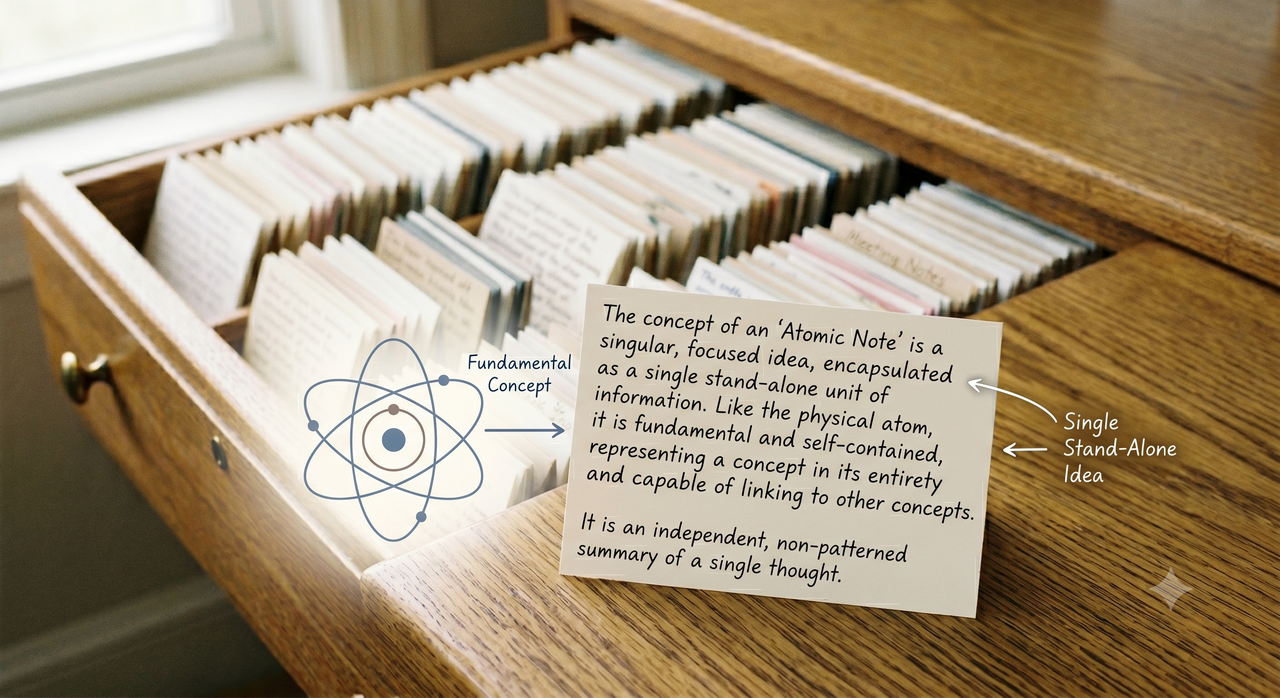
In your Zettelkasten, these fundamental building blocks are called Atomic Notes.

Your initial notes, whether from reading a book or listening to a lecture, often resemble a messy stream of consciousness. If you revisit these raw observations ten years from now, you will likely lose their original meaning. We create Atomic Notes to distil those raw, tangled thoughts into clear, singular insights. By doing so, you are building a “second mind” where your ideas can organically interact and connect over a lifetime.

The 3 Golden Rules of an Atomic Note

To successfully translate a raw note into an Atomic Note, you must follow three structural rules:

  1. The Rule of One (Atomicity) Every atomic note must contain exactly ONE distinct, self-contained thought. If a single sentence or passage expresses one unified idea—like a definition and its immediate implication—you can keep it together as one cohesive note. However, if your raw note contains genuinely separate insights, you must split them apart into their own individual notes.
  2. Standalone Clarity (Future-Proofing) You must rewrite the idea using your own conceptual words. Your note must make complete sense on its own to someone reading it 10 years from now, entirely liberated from the context of the surrounding sentences or the original book.
  3. Conversational Intent (Make it Alive) Do not simply write a dry summary. Write the note as an active, evergreen statement or argument. Because the Zettelkasten acts as a communication partner, phrasing your notes as active arguments allows them to naturally connect and converse with completely unrelated topics in the future.

Let's Look at an Example

Imagine you are reading a biology text and you jot down this raw, unstructured note:

Your Raw Note: “Turtles rely on hard shells to protect against predators, though the Leatherback sea turtle is a weird exception with its soft, rubbery shell. Interestingly, certain turtles can also breathe underwater, using specialised organs near their tails.

If we try to turn this paragraph into a single note, the system will become confused. We have three distinct concepts jammed together: standard anatomical defence, an evolutionary exception, and aquatic respiration.

Here is how we apply the rules to create perfect, individual Atomic Notes out of this raw material:

Atomic Note 1 (The Main Idea)

Title: Turtle Shells as Anatomical Armour Note: Turtles possess hard, bone-like shells that function as permanent physical armour, providing them with essential protection against predators in their environment.

Atomic Note 2 (The Exception)

Title: The Soft Shell of the Leatherback Note: While most turtles rely on hard bone for protection, the Leatherback sea turtle is a unique evolutionary exception, utilising a soft, rubbery shell instead.

Atomic Note 3 (A Completely Different Concept)

Title: Aquatic Respiration in Turtles Note: Certain species of turtles have developed the unique biological ability to breathe underwater through specialised organs, allowing them to remain submerged for extended periods.

Why Did We Do It This Way?

By splitting that one messy paragraph into three separate cards, we perfectly adhered to the rule of Atomicity. We rewrote them in our own words to guarantee standalone clarity.

Most importantly, because these ideas are now separated, they are liberated to grow oentirelyly different parts of your knowledge tree. Note 1 and Note 2 can be stacked vertically next to each other because they are both engaged in a conversation about “shells.” But Note 3 can now be planted on a brand new branch that is dedicated entirely to “aquatic respiration.”

If you had kept them all mashed together in one note, you would never be able to cleanly connect your new turtle-breathing note to a future note about how dolphins breathe. By making your notes atomic, you prevent information silos and allow your ideas to branch out and form brilliant, unexpected connections across your entire matrix.

It is a significant question: Should I create a Zettelkasten? The answer depends on a variety of personal factors. If you are an avid note-taker who feels exasperated that your thoughts never surface into anything meaningful, or if you constantly struggle to find information and feel as though you are wasting your time, a Zettelkasten can correct those issues for you.

However, before you dive in, there is a fundamental truth you must accept: a Zettelkasten takes effort, and it takes time. It is not a system where you can simply feed in your existing notebook or leaf system and expect it to build itself. Think of it like going to the gym. There is no point in purchasing a membership if you never actually show up. The same applies here; you cannot expect the system to do the work for you. It requires nurturing, focus, and a daily commitment.

The Economics of Scale and Proximity

To get any value out of a Zettelkasten, it needs a steady influx of data. If you aim to add just five notes per day, you will accumulate 150 notes in a month. Conversely, if you only find the time to add five notes a week, it will take an incredibly long time to yield anything worth having.

When building your collection, structure is vital. The ideal approach is to use established academic and scientific disciplines to organise your system, as they are designed to cover every branch of human knowledge. The real danger for beginners is a lack of thematic proximity.

If you create two notes about sport, one about note-taking, one about chemistry, and three about physics, you will technically have a Zettelkasten—but it will be utterly useless to you.

Without connection, notes simply sit as isolated root nodes in their respective domains. If your physics notes are entirely unrelated—one on gravity and another on an obscure scientific interest—they cannot link together. Without physical or conceptual connections, there is almost no point in having the system.

If you are going to cover multiple areas of knowledge, you must ensure consistent growth across those topics so that connections can naturally form. If you are up against tight, short-term deadlines, a Zettelkasten is not the route for you. It is a medium-to-long-term investment.

Active Engagement vs. Automated Ingestion

For voracious readers who capture highlights on digital devices like a Kindle or Kobo, these highlights serve as excellent source material to flesh out your digital slip-box. However, a Zettelkasten is not built by bulk-importing text and leaving it at that; it is achieved by processing each note individually.

We designed the Mind Dump Zettelkasten to make this process easy, but we intentionally do not make it entirely friction-free. It is possible for someone who does not even understand the basic principles to create a useful system, but it still demands intellectual engagement.

[Raw Highlights/Source] ➔ [Read & Understand] ➔ [Rewrite in Own Words] ➔ [Evaluate AI Placement]

Even if you use automated tools to rapidly push notes through, it will still take a minute or two per note. Conceivably, you could bang out 30 to 60 notes an hour using automated systems. But with that lack of personal engagement, will they actually be good notes?

While the AI inside Mind Dump is exceptional at doing the heavy lifting—such as generating atomic notes and suggesting logical placements—the quality of your Zettelkasten will immediately be diluted if you work on autopilot.

For instance, if you simply blind-accept the first location the AI suggests and entirely ignore the system's built-in collision detector—the feature that flags duplicate ideas or overlapping arguments so you do not repeat the same point in different places—you miss the whole point of the methodology.

To maintain system integrity, you must actively participate in the process:

  • Read the note thoroughly.
  • Understand exactly what it means.
  • Pay attention to collision warnings to keep your digital space clean.
  • Rewrite thoughts in your own words to enhance your memory and understanding.

The Limitations of AI

AI brings incredible capabilities to note-taking, but it is far from perfect. It faces limitations, including the tendency to hallucinate. While we are constantly altering and refining our background prompting to mitigate these issues, parsing human language remains highly complex. Language provides incredible flexibility, but it introduces immense human complexity. Processing human knowledge is never a repetitive, automated task; it requires deep, genuine understanding.

Who Benefits Most?

Writers are amongst the primary beneficiaries of dedicated note-taking applications. The legendary sociologist Niklas Luhmann famously used his physical Zettelkasten to write dozens of books, and his system was so robust that books continued to be published in his name even after his death. That is the ultimate testament to the power of the framework.

But what if you are not a writer? You might be a “knowledge explorer”—someone who takes notes but rarely uses them to expand their horizons. The very act of writing your own atomic notes is a phenomenal way to enhance memory and deepen your comprehension of a subject.

How to Start: Dip a Toe

If you are excited by knowledge, you should consider creating your own Zettelkasten, whether it lives in a physical box or inside Mind Dump. If you just want to test the waters, don't try to categorise everything at once.

  • Pick a single subject: Choose one book or topic you are currently reading.
  • Focus exclusively on it: Create atomic notes around this single source.
  • Analyse the matrix: Use the system to look at the connections and find the hidden depth in what you have learned.

If you focus on one subject intensely, you will be genuinely surprised by what the Zettelkasten can provide. Give it a go—just don't expect a miraculous result by this afternoon.