How to Build a Powerful Atomic Note
Imagine you are constructing a complex, modular architecture. To build something durable and adaptable, you need standardised, individual building blocks that can connect seamlessly with each other.
In your Zettelkasten, these fundamental building blocks are called Atomic Notes.
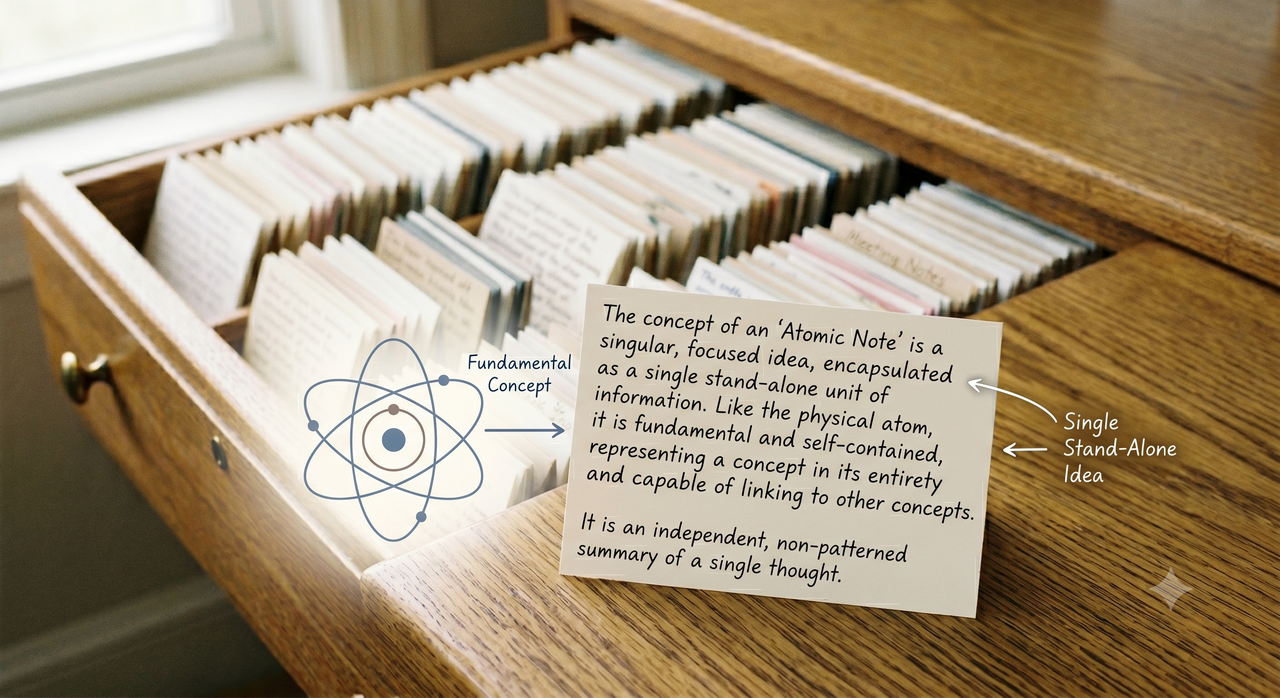
Your initial notes, whether from reading a book or listening to a lecture, often resemble a messy stream of consciousness. If you revisit these raw observations ten years from now, you will likely lose their original meaning. We create Atomic Notes to distil those raw, tangled thoughts into clear, singular insights. By doing so, you are building a “second mind” where your ideas can organically interact and connect over a lifetime.
The 3 Golden Rules of an Atomic Note
To successfully translate a raw note into an Atomic Note, you must follow three structural rules:
- The Rule of One (Atomicity) Every atomic note must contain exactly ONE distinct, self-contained thought. If a single sentence or passage expresses one unified idea—like a definition and its immediate implication—you can keep it together as one cohesive note. However, if your raw note contains genuinely separate insights, you must split them apart into their own individual notes.
- Standalone Clarity (Future-Proofing) You must rewrite the idea using your own conceptual words. Your note must make complete sense on its own to someone reading it 10 years from now, entirely liberated from the context of the surrounding sentences or the original book.
- Conversational Intent (Make it Alive) Do not simply write a dry summary. Write the note as an active, evergreen statement or argument. Because the Zettelkasten acts as a communication partner, phrasing your notes as active arguments allows them to naturally connect and converse with completely unrelated topics in the future.
Let's Look at an Example
Imagine you are reading a biology text and you jot down this raw, unstructured note:
Your Raw Note: “Turtles rely on hard shells to protect against predators, though the Leatherback sea turtle is a weird exception with its soft, rubbery shell. Interestingly, certain turtles can also breathe underwater, using specialised organs near their tails.
If we try to turn this paragraph into a single note, the system will become confused. We have three distinct concepts jammed together: standard anatomical defence, an evolutionary exception, and aquatic respiration.
Here is how we apply the rules to create perfect, individual Atomic Notes out of this raw material:
Atomic Note 1 (The Main Idea)
Title: Turtle Shells as Anatomical Armour Note: Turtles possess hard, bone-like shells that function as permanent physical armour, providing them with essential protection against predators in their environment.
Atomic Note 2 (The Exception)
Title: The Soft Shell of the Leatherback Note: While most turtles rely on hard bone for protection, the Leatherback sea turtle is a unique evolutionary exception, utilising a soft, rubbery shell instead.
Atomic Note 3 (A Completely Different Concept)
Title: Aquatic Respiration in Turtles Note: Certain species of turtles have developed the unique biological ability to breathe underwater through specialised organs, allowing them to remain submerged for extended periods.
Why Did We Do It This Way?
By splitting that one messy paragraph into three separate cards, we perfectly adhered to the rule of Atomicity. We rewrote them in our own words to guarantee standalone clarity.
Most importantly, because these ideas are now separated, they are liberated to grow oentirelyly different parts of your knowledge tree. Note 1 and Note 2 can be stacked vertically next to each other because they are both engaged in a conversation about “shells.” But Note 3 can now be planted on a brand new branch that is dedicated entirely to “aquatic respiration.”
If you had kept them all mashed together in one note, you would never be able to cleanly connect your new turtle-breathing note to a future note about how dolphins breathe. By making your notes atomic, you prevent information silos and allow your ideas to branch out and form brilliant, unexpected connections across your entire matrix.