Zettelkasten Online

Before explaining the Atomic Note, I feel it is only right to face the historical facts of Luhmann's own Zettelkasten. I want Mind Dump's Zettelkasten to be as open as possible and not try to deliberately mislead the user.

If you’ve spent any time in the modern note-taking circles, you’ve probably heard of the Principle of Atomicity spoken of as a sacred ancient commandment. The rule is simple: one note, one distinct idea, fully self-contained. We are always told that this is the very secret weapon used by the great German sociologist Niklas Luhmann to build his legendary 90,000-card paper slip-box.

But what if that’s not quite right?

What if the “atomic note” is a modern invention? And what if your digital Zettelkasten is totally reliant on it anyway? Let's face history, think about the architectural limits of paper versus screens, and explore why atomicity is the ultimate gateway to building a digital mind.

The Historical Reality: Constant Flows in Luhmann

One thing is clear: Niklas Luhmann did not impose strict atomicity on himself. His box is a modern myth: in it are cards each isolated perfectly, each with a single thought. Leading researchers and historians who have closely examined his physical archives observe that Luhmann often wrote long, unbroken trains of thought that spanned multiple physical index cards. If it took three cards to finish an argument, he just kept writing.

In fact, the word “atomicity” itself wasn’t even injected into the Zettelkasten vocabulary until a blog post in September 2013. It was later popularised by modern productivity authors, who retroactively applied the rule to make the system easier to teach.

Even the most passionate defenders of old-school, analogue paper systems — who decry the use of modern digital methods — agree that atomicity was never a primary feature of the original slip-box. But these same analogue purists make an interesting concession: atomicity is a very useful, if not essential, practice for digital systems.

And here is the case.

The Infinite Space Trap: Paper vs. Pixels

Why did Luhmann get away with long continuous streams of thought, while your digital note-taking app turns into an unusable mess if you try the same thing? It’s all about the physical boundaries.
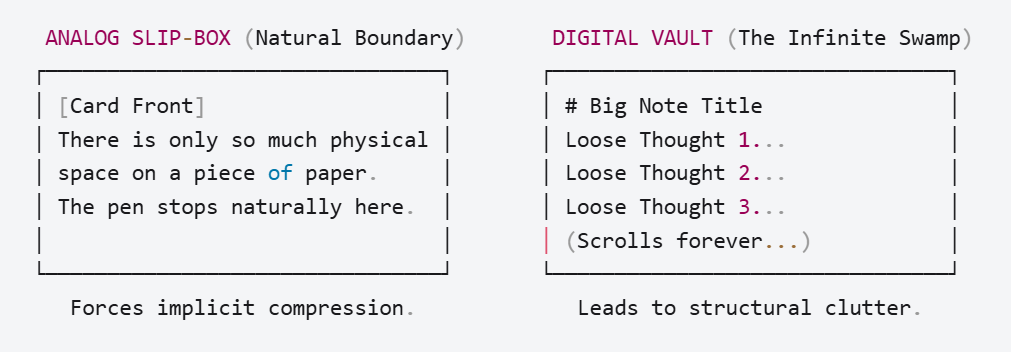
When Luhmann sat at his desk, he was naturally limited in his writing by the physical dimensions of a small paper index card. There is only so much you can put on a small piece of card stock before you run out of room. This physical limitation imposed an implicit discipline, he had to be concise, compressed and focused.

Digital systems are not bound by physical limitations. You have unlimited space in a markdown file. The human brain without limits goes the way of least resistance. We cut and paste huge articles; we write long, multi-topic essays; we produce bloated documents.

Instead of a structured web of knowledge, our digital vaults often become what experts call an “information swamp” — a heavy, unorganised pile of leaves where individual insights are buried alive. The lost physical boundary is replaced by a strict digital discipline, enforced digitally, of atomicity.

Why Your Slip-Box AI Needs “The Rule of One”

In Mind Dump's advanced digital environment, atomicity is more than just making your notes look clean. It’s a challenging technical requirement that unlocks the real power of an automated smart workspace.

Like a precision traffic controller, Mind Dump employs an AI engine to process your notes. It reads the deep conceptual meaning of your writing to find its perfect home in your matrix and surface long-distance links.

If you feed the system a bloated note with three different ideas crammed in, the logic falls apart:

  1. Accurate deconstruction and routing If a note touches a psychological habit, a business market trend and a software network tool simultaneously, the AI cannot calculate its true semantic position. It leads to a logical paradox. Thanks to the Rule of One, the AI can immediately analyse the one thesis of the card and send it to the precise neighbourhood where that particular conversation is taking place.
  2. Index bloat removal A clean index is a list of unique portals. If your notes are atomic, a keyword tag will take you to the very beginning of a very specific thought. Searching for a tag for multi-thematic notes produces tremendous walls of text, which causes cognitive overload.
  3. Performing organic branching (Folgezettel) Luhmann linked his notes to each other by creating continuous, branching chains of cards. For a digital system to replicate this process in an organic way, it needs clean blocks to build with.
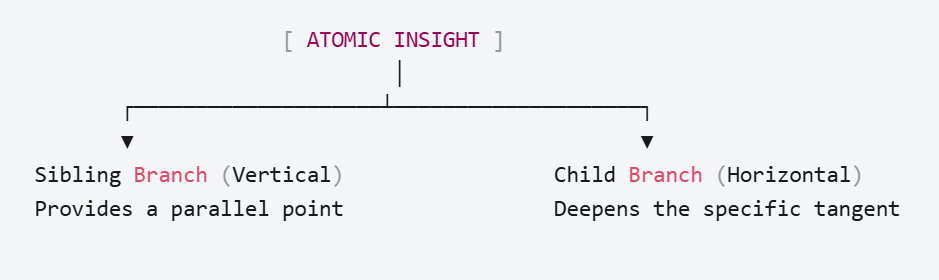
When your input is strictly atomic, Mind Dump’s architecture can very carefully chain subsequent thoughts. You can clearly place your first atom in the outline and then either route your next insights horizontally (a child to deepen a specific tangent) or vertically (a sibling to provide a parallel argument).

The Verdict: Automating the Soul in Analogue

The purists are right. Historically, the atomic note is a modern invention. Luhmann’s paper slips were much more fluid and continuous than the internet wants you to think.

But tools mould behaviour. We no longer have the natural borders of a physical card box, so we need to use digital constraints to safeguard our thinking. Mind Dump automates the rule of atomicity at the gateway to your workspace, capturing the true intellectual depth, clarity and surprise of the analogue slip-box, supercharged with the speed, memory and precision of a digital mind.

First it is necessary to explain a difference between Luhmann's physical Zettelkasten and the Mind Dump version. Luhmann famously created his system using boxes and note cards. His cards were stacked one behind the next. In Mind Dump Zettelkasten, the notes are presented in the form of a tree structure. The main, or root, notes are to the left, with the children and sibling notes spanning to the right. The basic form is the same; if Luhmann took a stack of cards out of his case to inspect them, he would have most likely laid them out on a table to read in a similar way, working from the left to the right and downwards.

Now imagine your Zettelkasten is not a rigid filing cabinet but a living, growing tree. Every time you write an atomic note, you are holding a single, newly sprouted leaf. Your goal is to figure out exactly where on the tree this new leaf belongs so it can connect naturally to the rest of the branches.

This process relies on the Rule of Proximity (Associative Chaining): you must always place your new leaf physically next to its closest conceptual neighbour. In this associative chain, the physical proximity of the cards acts as a link itself, ensuring that the closest neighbours inherently have the strongest links, mimicking how human memory actually chunks related concepts together.

When you are holding a new leaf, you have three basic choices for placement based on the internal branching (Folgezettel) system:

  1. The Child (The “And then...” leaf — visually horizontal) A child note is a direct, linear continuation of an existing note. It keeps the exact same conversation moving forward. Visually in the matrix, a child pushes out horizontally to the right (indenting), showing you have continued the subject and discussion. Example: If you have a leaf that says, “Turtles have hard shells to protect them,” a new note that says, “Because of this protection, turtles can live for a very long time,” is a child because it continues the exact same story.

  2. The Sibling (The “But what about...” or “For example...” leaf — visually vertical) A sibling note branches deeper into the conceptual hierarchy to start a mini-conversation. It is a specific tangent, a deeper detail, a functional application, or an exception to an existing note. Visually in your matrix, siblings are stacked vertically, parallel to the current node. Example: If your first leaf is “Turtles have hard shells”, a new note that says, “However, the Leatherback sea turtle has a soft, rubbery shell”, becomes a sibling because it introduces a specific exception. The discussion continues on the subject of turtles and their shells, but this time the discussion leads us to the Leatherback Turtle shell.

The Sibling (The “But what about...” or “For example...” leaf — visually vertical) Another sibling note again continues the conceptual hierarchy, and we start a new conversation. This time, our discussion continues the subject of animals with shells, but not turtles—only snails. The relationship is valid; both types of creature have protective shells. Even though turtles are reptiles and snails are molluscs, they both belong to the category of animals with protective shells. Example: If the next leaf is “Snails have hard shells to provide protection”, then the leaf becomes another sibling

  1. The New Root (The “Brand New Branch” leaf) Sometimes, you write a note that introduces a completely new paradigm that doesn't fit any current conversation. Example: A note about how “Aeroplanes fly because of the shape of their wings” belongs on a brand new root branch, far away from the biology of turtles.

The Placement Scaffold: Learning Through Scenarios

To master placement, you must learn to group notes by their intellectual consequence (the argument) rather than just matching nouns. Here is a progressive guide to navigating common placement scenarios:

Scenario 1: The Same Subject, Different Detail

The Situation: You have a note on “Turtle Shells”, and you write a new note on “Turtle Breathing under Water”. The Placement: You need to create a new root. Although both concepts belong to the biology of turtles, they are different discussions. Previously our interest was essentially about shells for protection, whereas in 'Turtle Breathing' this is about turtles, but actually the specific point of interest is 'breathing'. If we use the same approach as before, we make this node about 'turtle breathing'; we can also add 'dolphin breathing'. The two animals are unrelated – one is a reptile and the other a mammal – but the subject is breathing. So if we looked back at this note progression at a later time, we would find the interesting relationship between different animals breathing and not mix it up with protective shells. Think of it also like this: if we had added Turtle Breathing to the turtle's protective shell, there is no way of progressing the discussion, other than to say, 'Turtles have a protective shell' AND 'Turtles breath.' In contrast, with the Turtle-Dolphin example, we could advance the discussion by stating: 'Turtles are aquatic reptiles that breathe air at sea level and then submerge for extended periods of time,' and 'Dolphins are aquatic mammals that breathe at sea level and submerge for extended periods of time.'' ' We can continue to explore breathing in the animal kingdom without binding the discussion to a single animal or group.

Scenario 2: Avoiding the “Encyclopedic Trap”

The Situation: You have a note on “Turtle Shells”, and you write a new note on “Terrapin Diets”. The Placement: If you stack them vertically together simply because both are reptiles, you fall into the encyclopaedic trap—treating your thinking system like a static biology textbook. The Terrapin Diet becomes a new root because “diet and feeding habits” is a completely different conversation from “anatomical shell protection.”

Scenario 3: Trusting Organic Branching

The Situation: You already have the “Terrapin Diet” root. Now you write a note about a “Turtle's Diet” and later, a note about a “Cow's Diet”. The Placement: The “Turtle Diet” goes right below the “Terrapin Diet” as a vertical sibling. What about the cow? Even though a cow is a mammal, the true conversation is about feeding habits. Therefore, the “Cow's Diet” is stacked vertically next to the turtle and terrapin diets, making it another sibling in this context. The lesson: This is organic branching. You never needed to create a rigid, pre-planned folder for “All Animal Diets”. By simply putting these siblings sequentially next to each other, the branch organically zooms out and becomes a massive branch about animal diets.

Scenario 4: The Executive Tie-Breaker

The Situation: You write a note about “Human Eating Rituals”. It is about diets, but it is focused on humans. The Placement: You must stop and evaluate the true intellectual consequence of the note. While it involves eating, the conversation has shifted from biology to sociology and anthropology. Therefore, it cannot be positioned vertically with the animal diets (natural science); instead, it becomes a new root in the social science domain.

The Situation: You write a note about “Religious Rituals” and want to connect it to “Human Eating Rituals”. However, strict explicit domain boundaries dictate that religion must go in the humanities domain, while your eating rituals are in social science. The answer is to plant “Religious Rituals” as a new root in the humanities. Then, at the bottom of the card, you write a full numeric-alpha address pointing back to “Human Eating Rituals”. This creates a Remotelink—a magic vine that bridges distant trees. It keeps your macro-domains perfectly disciplined by academic argument but allows you to swing across the forest to discover unexpected, genius-level insights (bisociation).

The Golden Rule: Enhancements vs. Identical Twins

When placing notes, you will often be tempted to merge them together just because they share keywords or possess a high semantic match. You must only merge a new note into an old note if it makes the exact same fundamental claim and offers no new intellectual move. If the new note adds a new consequence, a specific critique, an unexpected analogy, or a functional application, it enhances the matrix. It must be given its space and placed as a vertical sibling or a horizontal child to extend the paper trail of meaning. The Zettelkasten is a communication partner: follow-up notes organically extend a conversation; they are not folded into a single bloated card. Let your ideas breathe, let them branch, and let your tree of knowledge grow.

Welcome to zettelkasten.online.

I first came across Niklas Luhmann's Zettelkasten note-taking system a few years ago and could immediately see its greatness. Having been frustrated with existing systems, I found that highlighting and scribbling did not produce a lasting knowledge base that I could use to strengthen my understanding or turn into anything but a labyrinth of impenetrable notes. But there were several aspects of the Zettelkasten system that limited my interest, the main one being hand-written notes stored in a physical box.

I am afraid I lack space for note-taking like this method and do not enjoy writing with a pen. My handwriting is not particularly good, not because I am unable to write with a pen, but because I have spent my entire professional life typing on a keyboard. The prospect of picking up a pen didn't excite me in the slightest. Furthermore, my life at that time was mobile; I wanted something that would enable immediate note-taking and processing. I would rather not spend five days away from home, only to return to decipher and process my notes. I am afraid I am a product of the “I need it now” world.

I tried to implement some of the techniques with digital writing tools, but it didn't work. The most compelling aspect of Luhmann's system is not the act of adding notes, although both the notes and the structure are essential. Instead, it is the output that I wanted: using my personal notes to help my future self. Without the Zettelkasten structure, this output does not occur.

In 2025, I started to develop Mind Dump, its roots set as a task management platform, but as I explored my different areas of interest, I branched the application into personal knowledge management, implementing a mind map and outliner. One of my fundamental demands of Mind Dump is what I call the “capture surface.” To be a truly useful task manager and personal knowledge manager, capturing notes and data had to be as friction-free as always.

As I progressed, it became clearer and clearer that if I were to reach my own goals, I needed to revisit the Zettelkasten method.

But I didn't want to simply recreate another enhanced note-taking system that just pays homage to Niklas Luhmann's original system; I wanted a solution that adopted his techniques.

The difficulty with the Zettelkasten is that to make it work properly, we must at least obey two fundamental principles: atomic notes* and feste Stellordnung, which translates to “fixed position ordering.” We will discuss these terms often, but for the moment, it is enough to know that for Mind Dump to work, these two principles are essential.

A Zettelkasten is not a simple notebook, and it doesn't just write itself; it needs time, engagement, and understanding. Understanding these factors is crucial, as they create friction in note processing. My thinking was that with modern AI systems, it should be possible to ease the experience for people unfamiliar with the Zettelkasten method.

Although AI is baked into the system, I wanted the background to be accessible to users who wanted to build their own Zettelkasten outside of the AI tools.

So the Mind Dump Zettelkasten, as you see it today, is a hybrid AI/manual Zettelkasten background with a smooth UI and a friction-free note-capture interface.

Mind Dump Zettelkasten is still in development and advances daily as I work with my own Zettelkasten and adopt smoother approaches to everything.

My next post will focus on what you can expect your own Zettelkasten to give you.

*The concept of “atomicity” (strictly limiting one idea per note) was popularized by modern digital Zettelkasten proponents, such as Sönke Ahrens, rather than by Luhmann himself. In reality, Luhmann’s notes were often continuous streams of thought that carried over across multiple notecards to form chain-linked structures.