The Myth Buster: Why Your Digital Zettelkasten Really Needs the “Atomic Note”
Before explaining the Atomic Note, I feel it is only right to face the historical facts of Luhmann's own Zettelkasten. I want Mind Dump's Zettelkasten to be as open as possible and not try to deliberately mislead the user.
If you’ve spent any time in the modern note-taking circles, you’ve probably heard of the Principle of Atomicity spoken of as a sacred ancient commandment. The rule is simple: one note, one distinct idea, fully self-contained. We are always told that this is the very secret weapon used by the great German sociologist Niklas Luhmann to build his legendary 90,000-card paper slip-box.
But what if that’s not quite right?
What if the “atomic note” is a modern invention? And what if your digital Zettelkasten is totally reliant on it anyway? Let's face history, think about the architectural limits of paper versus screens, and explore why atomicity is the ultimate gateway to building a digital mind.
The Historical Reality: Constant Flows in Luhmann
One thing is clear: Niklas Luhmann did not impose strict atomicity on himself. His box is a modern myth: in it are cards each isolated perfectly, each with a single thought. Leading researchers and historians who have closely examined his physical archives observe that Luhmann often wrote long, unbroken trains of thought that spanned multiple physical index cards. If it took three cards to finish an argument, he just kept writing.
In fact, the word “atomicity” itself wasn’t even injected into the Zettelkasten vocabulary until a blog post in September 2013. It was later popularised by modern productivity authors, who retroactively applied the rule to make the system easier to teach.
Even the most passionate defenders of old-school, analogue paper systems — who decry the use of modern digital methods — agree that atomicity was never a primary feature of the original slip-box. But these same analogue purists make an interesting concession: atomicity is a very useful, if not essential, practice for digital systems.
And here is the case.
The Infinite Space Trap: Paper vs. Pixels
Why did Luhmann get away with long continuous streams of thought, while your digital note-taking app turns into an unusable mess if you try the same thing? It’s all about the physical boundaries.
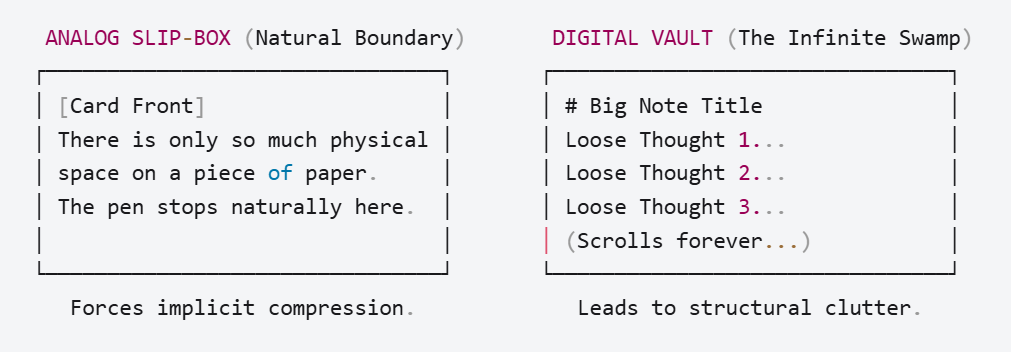
When Luhmann sat at his desk, he was naturally limited in his writing by the physical dimensions of a small paper index card. There is only so much you can put on a small piece of card stock before you run out of room. This physical limitation imposed an implicit discipline, he had to be concise, compressed and focused.
Digital systems are not bound by physical limitations. You have unlimited space in a markdown file. The human brain without limits goes the way of least resistance. We cut and paste huge articles; we write long, multi-topic essays; we produce bloated documents.
Instead of a structured web of knowledge, our digital vaults often become what experts call an “information swamp” — a heavy, unorganised pile of leaves where individual insights are buried alive. The lost physical boundary is replaced by a strict digital discipline, enforced digitally, of atomicity.
Why Your Slip-Box AI Needs “The Rule of One”
In Mind Dump's advanced digital environment, atomicity is more than just making your notes look clean. It’s a challenging technical requirement that unlocks the real power of an automated smart workspace.
Like a precision traffic controller, Mind Dump employs an AI engine to process your notes. It reads the deep conceptual meaning of your writing to find its perfect home in your matrix and surface long-distance links.
If you feed the system a bloated note with three different ideas crammed in, the logic falls apart:
- Accurate deconstruction and routing If a note touches a psychological habit, a business market trend and a software network tool simultaneously, the AI cannot calculate its true semantic position. It leads to a logical paradox. Thanks to the Rule of One, the AI can immediately analyse the one thesis of the card and send it to the precise neighbourhood where that particular conversation is taking place.
- Index bloat removal A clean index is a list of unique portals. If your notes are atomic, a keyword tag will take you to the very beginning of a very specific thought. Searching for a tag for multi-thematic notes produces tremendous walls of text, which causes cognitive overload.
- Performing organic branching (Folgezettel) Luhmann linked his notes to each other by creating continuous, branching chains of cards. For a digital system to replicate this process in an organic way, it needs clean blocks to build with.
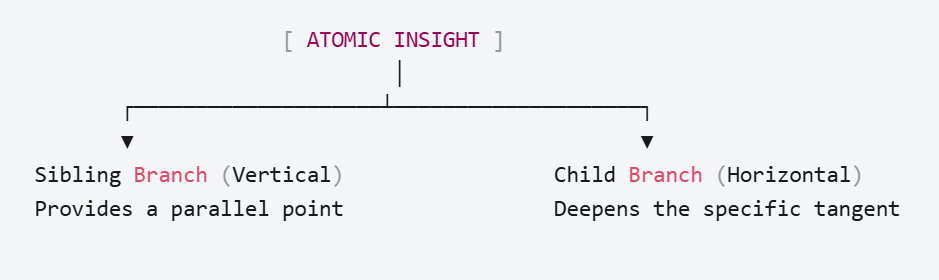
When your input is strictly atomic, Mind Dump’s architecture can very carefully chain subsequent thoughts. You can clearly place your first atom in the outline and then either route your next insights horizontally (a child to deepen a specific tangent) or vertically (a sibling to provide a parallel argument).
The Verdict: Automating the Soul in Analogue
The purists are right. Historically, the atomic note is a modern invention. Luhmann’s paper slips were much more fluid and continuous than the internet wants you to think.
But tools mould behaviour. We no longer have the natural borders of a physical card box, so we need to use digital constraints to safeguard our thinking. Mind Dump automates the rule of atomicity at the gateway to your workspace, capturing the true intellectual depth, clarity and surprise of the analogue slip-box, supercharged with the speed, memory and precision of a digital mind.